Sunday, August 7, 2016

Encrypted Texting & Phone Calls for Attorneys & Protesters

Texting and Facebook messaging has become the modern protester’s First Amendment communicative choice. However, when you are protesting the government, you might be asking for a subpoena.  As an attorney, if you are giving legal advice to a suspect or defendant, your privileged communications are at risk.  Even if you are simply having a conversation about the weather you are still asking to get hacked on Facebook or at risk of losing your phone. Additionally, if you are traveling abroad, your phone transmissions are vulnerable to electronic intercept, as Hillary Clinton was apparently unaware of when using her mobile devices. These risks all came to light thanks to Edward Snowden.

[ADVERTISEMENT: Buy a Pocket Constitution on Amazon. Proceeds to Oregon schools!]

That’s where the apps Wickr and Signal come on.  Wickr is like a Cloak and Dagger version of Snapchat.  (Snapchat was hacked in 2014 and the personal details of chatters were placed online.) You can program your messages to self-destruct within seconds and you are notified if the recipient takes a screenshot. Assuming you trust the recipient, it is very secure. It is arguably only at risk if the recipient uses another camera to take a photograph of his or her screen.

Technology has changed since Red Dawn - Our rights haven't.
Buy a pocket constitution! Proceeds to Oregon schools!


Signal is also an encrypted texting program but it doesn’t self-destruct.  It is a great alternative to traditional texting but still leaves the recipient as the vulnerable link in the chain. However, it does have wonderful encrypted voice phone calling capabilities. 

Attorneys would be wise to use these when communicating with clients.  Diplomats already are using them internationally. And if you are an environmental protester or a Black Lives Matter protester fearing a Trump regime, you had better start planning ahead.  Likewise, if you are a constitutional originalist protester or blogger fearing a Hillary Clinton Department of Justice, this is also something to consider.


Nonetheless, in a world of electronic subpoenas and hackers and untrustworthy Facebook “friends,” consider this: Only put something in writing if you wouldn’t mind a jury, judge or prosecutor reading it or mind the world seeing it on the front page of a newspaper.  Discretion is king.  

by Mike Arnold, 8/7/2016

Mike Arnold is an Oregon attorney. He represented Ammon Bundy in the aftermath of the Malheur Wildlife Refuge occupation. His cases have been covered nationally, including a CBS "48 Hours" special, Trail of Tears (watch now online).  

Mike recently published a pocket constitution that is now an Amazon #1 New Release.  All proceeds go to Oregon schools.  Buy now while supplies last! (paperback or Kindle)

Tuesday, July 19, 2016

Judge Jones: Ammon & Ryan Bundy to Stay in Jail Pending Trial (complete order)


Case 3:16-cr-00051-BR Document 903 Filed 07/19/16 Page 1of 3

UNITED STATES DISTRICT COURT FOR THE DISTRICT OF OREGON PORTLAND DIVISION

UNITED STATES OF AMERICA,
Plaintiff,
v.
AMMON BUNDY, RYAN BUNDY

Defendants.


Case. No. 3:16-00051-BR
ORDER ON MOTION FOR
RELEASE FROM PRETRIAL
DETENTION

Jones, J.
Defendants Ammon and Ryan Bundy appeared before this court on their Joint Motion to Revoke Detention Orders and Motion for Pretrial Release (#892). After hearing argument from the parties, I make the following findings.
Ammon Bundy and Ryan Bundy each has a wife and children, a home and a business to attend. Neither man possesses a passport. Defendants have strong ties to family and their father, who led an armed standoff in Bunkerville, Nevada in 2014. Defendants participated in that purportedly illegal activity and are now on court detainer from the Nevada federal court.
Two years after the activities in Nevada, Ammon and Ryan Bundy concede that they were the instigators and leaders of the group that occupied the Malheur Wildlife Refuge, which they named the "Citizens for Constitutional Freedom." The group was aimed with weaponry with which to resist intervention by federal authorities. Authorities seized over 50 firearms,

Case 3:16-cr-00051-BR Document 903 Filed 07/19/16 Page 2 of 3

6000 rounds of live ammunition and 1000 rounds of spent shell casings from the Malheur site following the occupation. Defendants directed the group to set up a perimeter to control ingress and egress. They posted military-style armed personnel to create and patrol a perimeter of the site and to man an overlook tower. Ammon Bundy cut down a government fence at the refuge. Defendants ignored requests to disperse. They based their actions on their misinterpretation of adverse possession law and their misguided interpretation of criminal and constitutional law.
As to Ryan Bundy, he does indeed present some risk of flight as demonstrated by his aborted attempt to escape custody. In Ryan Bundy's cell, jail personnel found a rope made with multiple sheets tied together, additional strips of torn sheets, extra pillow cases, towels, clothing and food. I reject his excuse that he was practicing braiding.
While I find they do not pose a risk of fleeing the country, I find their participation in the armed standoff in Nevada and the fact that they condoned the use of an arsenal of weapons at the Malheur Wildlife Refuge demonstrate they believe they are justified in refusing lawful federal orders. Furthermore, they believe that placing an armed force between officials seeking to enforce lawful orders and themselves justified by their interpretation of the Constitution.
Thus, I find it likely that if released, they may well ignore the conditions of release imposed by this court and enforced by a federal pretrial services officer. They may fail to appear for court hearings and trial. More dangerously, they may attempt to recruit another standoff or occupation just as in the Nevada episode in 2014 and at the Malheur Wildlife Refuge earlier this year and to resist with armed forces federal authorities enforcing lawful federal orders. These factors are sufficient to satisfy me with clear and convincing evidence that no combination of conditions I can impose would reasonably assure their appearance in court or the safety of the community.

Case 3:16-cr-00051-BR Document 903 Filed 07/19/16 Page 3 of 3

Defendants' Joint Motion to Revoke Detention Orders and Motion for Pretrial Release is DENIED (#892). Ammon Bundy's Motion to Consolidate Pretrial Detention Hearings with the Nevada court (#881) is DENIED and Ryan Bundy's Motion for Joinder to that motion (#893) is MOOT. What the Nevada court does as to its detention order is up to that court without intervention or consolidation with this court. It is so ordered.
\
Dated this _d day of July, 2016.


 Robert T. Jones, Senior Judge

United States District Court

Friday, July 15, 2016

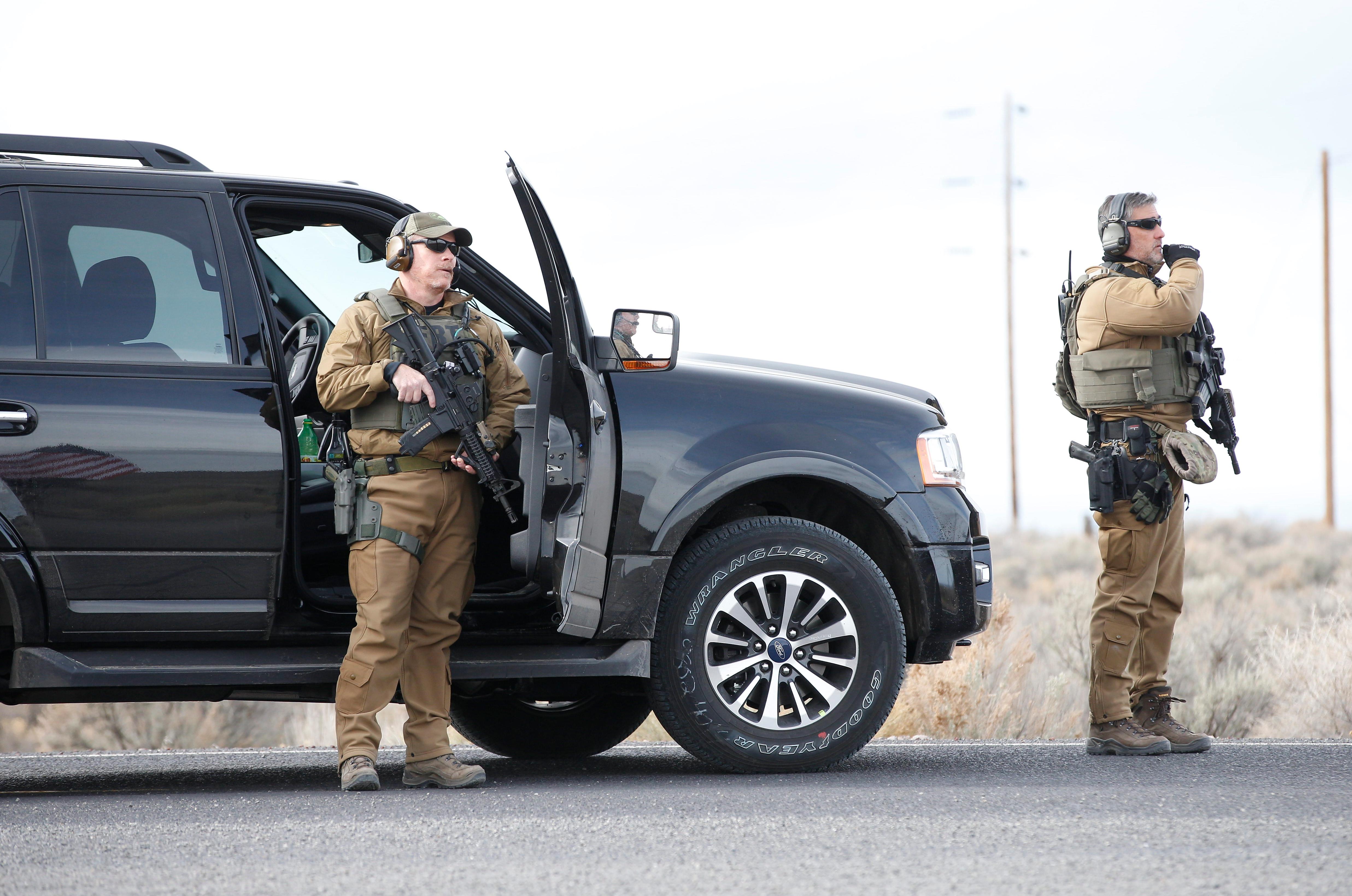
Harney County Residents: “Danger and Intimidation” in Burns by FBI “militarized zone;” agents “aggressive and threatening” with “fingers on triggers”

In support of their motion for release, Ammon Bundy’s attorneys attached 22 affidavits of witnesses who rebutted the government narrative that the refuge was damaged by the protestors and that the protesters were intimidating.  The defense contends through these witnesses that the government siege of Harney County was intimidating to residents and visitors alike.

[Download affidavits here.]

Agents had hands on gun holsters

A 65-year-old, lifetime resident of Harney County swore that he visited the refuge a number of times and “found the people there to be friendly.” He said that “[t]hey did not stop anyone from coming or going, and anyone was welcome to go there and talk with them.”

FBI Agents in Harney County
He argued that “the town of Burns became occupied with dozens of heavily armed government troops.” 

He that approximately three days after LaVoy Finnicum’s death, he had engine problems and pulled over and popped the hood to inspect it near the Grange Hall.  He said that he was “soon approached by armed government agents. The agents had their hands on their gun holsters, and the holsters appeared to be unsnapped.”

“A Militarized Zone”

Another Harney County resident, a woman, was curious about the protest and visited the refuge in January.  She “found the people gathered at the Refuge” to be “nonthreatening and very friendly.” She said that no one was blocking the entrance or stopping people from coming and going.  She also observed that the “place was very clean and well maintained.”

She contrasted that experience with the “danger and intimidation” in Burns due to the “armed FBI agents [who] took over the town and turned it into a militarized zone.” She saw more guns on the FBI agents around town than among the people at the refuge. 

Refuge never barricaded; open to all comers

A Harney County rancher swore that the refuge was never barricaded and the public “always had an unfettered right to enter the Refuge at any time and to stay as long as anyone wanted to.” He also pointed out that it was customary to go armed to the refuge and to open carry rifles, which doesn’t alarm the surrounding community. 

The three times he visited during the protest he saw no guns displayed and he “walked and drove freely around the place.” He contrasted that to the government occupation of Harney County which “was being swarmed by hundreds of heavily-armed government agents of all types. [He] saw many dozens of military-style law enforcement vehicles around Burns” and three “Blackhawk-style military government helicopters in Harney County.”

Governments agents brandished firearms recklessly

He saw dangerous posturing by government agents at the Harney County Courthouse, recklessly brandishing firearms, many with “fingers on the triggers” that “appeared aggressive and threatening.”

USFWS Employee Not Impeded?

An Idaho “citizen journalist” claimed to have seen a uniformed US Fish and Wildlife Service  employee at the refuge talking to Ryan Bundy. That USFWS man “then casually walked to his US government vehicle and drove away.”

Aggressive FBI Agents Around Town
Another man claimed that FBI agents “appeared to drive like reckless drunk drivers, speeding up behind people and then slamming on their brakes.” He felt that the refuge was the “safest place to be in Harney County” during the occupation. 

Burns’ fire chief, Chris Briels, echoed the sentiments of the other affiants, noting that the government personnel in Burns was “very aggressive” with armed snipers on the roof of the courthouse.  He resigned as a result.

A 15-year female resident of Burns “observed that the local Burns law enforcement officials, joined by federal officials exploited and wildly exaggerated claims regarding constitutionalists camping at the [refuge.]”  She said that “Burns became a Soviet-style police state” with government agents everywhere.

Occupiers Cleaned Up Refuge

Another resident of Burns said that the USFWS “casually displayed Indian artifacts out front in the elements” and that the “condition of the place at the refuge improved and got cleaner during the four times that [he] visited during the occupation.”

A rancher from Harney County had observed the refuge before the occupation and stated that the facilities were “extremely filthy” and that “the government had allowed equipment and facilities to become deteriorated and in disrepair.”  He juxtaposed that with the protestors who “were busily cleaning up and fixing the facilities.”


A 48-year-old Cherokee/Choctaw man signed an affidavit claiming he had experience in indigenous toolmaking and stated that he was featured in a documentary on Oregon Public Broadcasting.  He swore that the Malheur Wildlife Refute “was never known as a significant or sacred Paiute Indian camping, settlement, or burial ground.”  He stated that it was no more significant than the rest of Harney County.

Release Hearing Pending

Next up for the Bundy Brothers is a new release hearing before District Court Judge Jones. 

[Download affidavits here.]

Friday, June 10, 2016

Second Amendment is About Self-Defense...against tyranny or foreign invaders.

What the Second Amendment really is about is insurance.  It is the most valuable insurance clause on the planet. It says that if you attempt to invade us, you will you have a big problem with an armed citizenry.  Take a look at the historical example with Japan and their likely fears of what would happen if they invaded the mainland of the United States (assuming they could ever had overcome the logistical and troop number problems).

Our troops in Okinawa, Japan on the eve of a main island invasion had to worry too but about a different armed citizenry.  The emperor was telling his subjects that they would be killed by the American invaders and to use pitchforks, shovels or whatever they had to defend themselves. Previously, before they were backed into the corner of what was remaining of their empire, the Japanese military knew better than to invade the west coast.  They would have had to worry about firearms hidden behind every door. America’s love, obsession, respect, or fetishism with firearms is a great warning sign to any potential invaders: Have gun, will travel….so you shouldn’t.


The self-defense concept within the Second Amendment also applies to our own government. It is an insurance policy making martial law or tyranny very unlikely. Of course, an armed militia of citizens can also lead to tyranny of the majority or mob rule, so we have a very delicate balance.  

Thursday, June 9, 2016

Un-Enumerated Rights: Bill of Rights isn’t an exhaustive list of rights

What most people forget is that the Bill of Rights isn’t an exhaustive list of rights. It was just the ones that the Founders compromised and traded on and felt were the most likely to be infringed upon by government. They just wanted to make it crystal clear for the government to back off of these rights. It isn’t an affirmative list of things you can do, but it is a partial list of what the government cannot infringe upon.

But back to the question of banning the right to self-defense addressed on June 8th (http://snip.ly/ban-self-defense). The fact that we can ponder this question and leave it unanswered is proof positive that the Second Amendment is something more than personal self-defense against other citizens or simply about hunting.  

For starters, it only mentions “arms” and doesn’t give any explicit rights protecting the left cross or right jab in the face of a threat. 

When talking to jurors about the right to self-defense or to clients about the use of deadly force as a gun owner, I often discuss how do you know you are in the right when you shoot or punch.  The answer for me personally is this: If you have to think about what the police or jury would think if you pulled the trigger or threw a punch then the threat probably isn’t imminent, and it’s probably time to remove yourself from this situation. 

If you are too scared or preoccupied with surviving the next 10 seconds, then you are more likely authorized unless you are the unfortunate “unreasonable” person who overreacted. But as they say, it’s better to be judged by twelve than carried by six. 


However, I will say that after years as a trial lawyer and many trials involving self-defense and juries, my own personal perception of an imminent threat has almost caused me to react differently to a threat.  With two recent examples of an attempted assault on me, my mind was still racing to “what would a jury think?”  I almost transcended the moment and slowed down time to think out everything as if in slow motion and what the consequences were to words.  

Of course that’s another story, but it was the backdrop to my first meeting with Gerald Strebendt in 2014. I had been in physical altercations before on and off the rugby pitch and more than one as an adult/attorney. The reactions he described and the information he claimed to have shared on the 911 call made me, based on my personal experience and of reading thousands of police reports, excited that he was probably innocent but fearful that his reactions based on his years of training would inevitable result in an indictment for murder.  

An indictment was issued and we spent our time and resources looking for evidence that supported the statute.  There were no constitutional claims because there is no explicit constitutional right to self-defense, which I have always found strange considering how fundamental it is to the right to life.

Wednesday, June 8, 2016

Could “Self-Defense” Be Banned by a Legislature? (Second Amendment is Not Self Defense Right or the Right to Bear Sporting Goods)


The second amendment is not about a right to self-defense and is not a right to keep and bear sporting goods, i.e., guns for hunting.  With that as a premise, could a state ban “self-defense. The right to self-defense isn’t in the constitution. It is a creature of statute.  In the Oregon Revised Statutes a person has the right to use the reasonable degree of force they reasonably believe necessary to stop or prevent imminent unlawful force of another.  So, what if that statute was removed from the books?  Absent jury nullification, could a person be successfully prosecuted for assaulting her attacker in self-defense?   Or does a person have an inalienable right to self-defense in certain circumstances?

Self-Defense not in Constitution because it’s a natural right

If a legislature chose to remove that defense from the statutes, would we still have that right? Is that “right” included under the "penumbra" of rights that liberal judicial activists have created or is it something that transcends the “penumbra” and is an innate human right?  Or is that what judicial activists were actually saying regarding the “penumbra”--  that there are certain things the government can’t outlaw due to natural rights, i.e., a women’s right over her body (abortion), and, in this hypothetical, the right to self-defense.

What’s on your mind?


Some prosecutors mislead jurors into concluding that how a defendant feels emotionally at the time of the assault/self-defense claim is also a factor to their “state of mind” for self-defense. For instance, I have heard them argue to jurors that if someone is angry or acting out of anger that means they weren’t truly afraid and trying to defend themselves.  That simply is not true.  Anger and fear are not mutually exclusive and many anthropologists, psychologists, or evolutionary biologists will tell you that both emotions probably evolved from common stimuli.  

Friday, December 5, 2014

All Lawyers Are in Sales: Attorney marketing is competitive just like the courtroom

Lawyers sell themselves to potential law employers to be hired.

Lawyers sell themselves to potential clients to be hired.

Lawyers sell their case strengths and settlement positions to adverse counsel to resolve cases.

Lawyers sell their legal arguments to judges to win motions.

Lawyers sell their cases to juries to win trials.

The old guard attorneys that have been retiring from practice over the last decade often see attorney marketing as shameful. However, they never needed to do it due to a high demand for lawyers and a low supply of lawyers when they started practicing. In otherwords, they were the only show in town when they made their mark.

Modern law practice is very competetive and requires sophisticated analysis of marketing trends.  The sales terms of "leads," "prospects," and "conversions" have become part of attorney vernacular.

While the traditional "low information" client back in the old guard days was impressed by fancy office furnishings, modern clients come to the initial attorney consultation informed by Internet searches.  They are in turn impressed by the information on a law firm's website and how good it looks. Clients know that if they aren't impressed by the firm's powers of marketing persuasion, the courtroom skill set just might not be there.

To survive in this modern world, attorneys must embrace this lawyer-salesman mindset. There is no shame in marketing with class and soft selling one's law firm to clients. Tacky TV ads are not the only option.  But there are options and they are many.

The possible places to spend attorney marketing funds are limitless and the attorney must be sophisticated or money is wasted. Many that you have to earn by the "point one." This is why the field of attorney marketing advisors has taken off.

It is very dangerous to rely solely on the advice of your ad rep from a particular company, as they have a vested interest in selling their product to you.  Instead, consider hiring a traditional marketing firm for advice. Or better yet, hire an attorney marketing consultant.  Spending money to educate yourself on the limitless marketing possibilities before committing marketing dollars is wise.

Remember, we scorn clients for pro se mistakes all the time. They truly get what they pay for. And so do we. Let's get advise from the experts. An attorney who is marketing himself truly has a fool for a client.

- Mike Arnold is the managing partner of Arnold Law in Eugene, Oregon. He is the firm's lead jury trial counsel and leads the firm's business practice decisions.